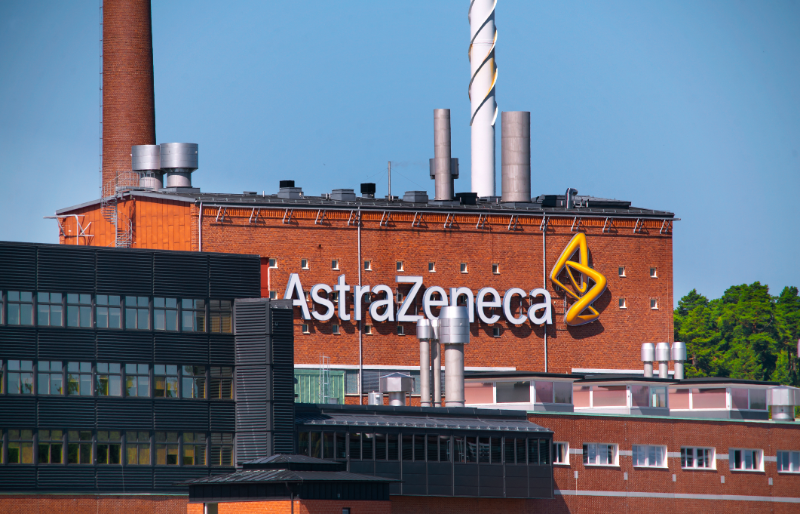
AstraZeneca secures global rights to novel lung cancer drug Zegfrovy in $1.5 billion deal with Dizal Pharmaceutical
LONDON: AstraZeneca has signed an exclusive global licensing agreement for Zegfrovy (sunvozertinib), a novel oral EGFR inhibitor for lung cancer patients with exon 20 insertion mutations.
In a landmark deal valued at up to $1.5 billion, AstraZeneca has entered into an exclusive global license agreement with China’s Dizal Pharmaceutical for Zegfrovy, an innovative oral targeted therapy for non-small cell lung cancer (NSCLC) patients with EGFR exon 20 insertion mutations, a statement said.
A Game-Changing Addition to AstraZeneca’s Portfolio
The agreement gives AstraZeneca worldwide rights to develop and commercialize Zegfrovy, complementing the company’s already robust portfolio of EGFR-mutated lung cancer treatments. The transaction includes an upfront payment of $600 million to Dizal, with additional milestone payments of up to $900 million based on development, regulatory, and sales achievements, plus tiered royalties on global sales.
Zegfrovy is already approved in both the United States and China for the treatment of adult patients with locally advanced or metastatic NSCLC whose tumors carry EGFR exon 20 insertion mutations and who have progressed on or after platinum-based chemotherapy.
Addressing a Critical Unmet Need
Lung cancer remains the leading cause of cancer death globally, with NSCLC accounting for 80-85% of all cases. Approximately 10-15% of NSCLC patients in the US and Europe, and 30-40% in Asia, have EGFR-mutated disease. Among these patients, roughly one in four carries an exon 20 insertion mutation or other atypical mutations for which targeted treatment options remain limited.
“Zegfrovy is the only oral targeted therapy for EGFR exon 20 insertion non-small cell lung cancer approved in the US and China for patients following prior systemic therapy,” noted Dr. Xiaolin Zhang, Chief Executive Officer of Dizal. “As a leading global company with a strong lung cancer franchise, AstraZeneca will help ensure patients around the world can benefit from this innovation discovered by Dizal scientists in China.”
Promising Clinical Data
Dizal recently announced positive results from the global WU-KONG28 Phase III trial evaluating Zegfrovy in first-line NSCLC with exon 20 insertion EGFR mutations. The data were presented as a Late-Breaking Abstract Oral Presentation at the 2026 American Society of Clinical Oncology Annual Meeting and simultaneously published in The New England Journal of Medicine—a testament to the significance of these findings.
Based on these results, a Supplemental New Drug Application has been submitted to both the US Food and Drug Administration and China’s Center for Drug Evaluation for first-line approval. Both regulatory agencies have granted Breakthrough Therapy Designation for Zegfrovy in this setting.
Clinical Guidelines Recognition
Sunvozertinib (Zegfrovy) has been included in the NCCN Clinical Practice Guidelines in Oncology for NSCLC as a Category 2A recommended subsequent therapy option for patients with EGFR exon 20 insertion mutation-positive advanced or metastatic disease.
A Strategic Addition to AstraZeneca’s Lung Cancer Pipeline
“Zegfrovy complements AstraZeneca’s leading portfolio of medicines targeting EGFR mutations,” said Dave Fredrickson, Executive Vice President of AstraZeneca’s Oncology Haematology Business Unit. “AstraZeneca is a leader in treating EGFR-mutated lung cancer, and we are eager to add Zegfrovy to our world-class portfolio of innovative medicines for patients whose tumours carry exon 20 insertion mutations. With this agreement, we will bring a differentiated, oral targeted treatment to these patients with limited options across the globe.”
Expanding the Oncology Arsenal
Zegfrovy, an irreversible EGFR inhibitor, targets a wide spectrum of EGFR mutations while maintaining selectivity for wild-type EGFR. Beyond exon 20 insertions, it has demonstrated encouraging anti-tumor activity in NSCLC patients with EGFR sensitizing, T790M, and uncommon mutations, as well as HER2 exon 20 insertions. The drug has shown a well-tolerated and manageable safety profile in clinical trials, with most adverse events being Grade 1/2 in nature.
Transaction Timeline
The transaction is expected to close in the second half of 2026, subject to customary closing conditions and regulatory clearances. AstraZeneca has confirmed that the deal does not impact its financial guidance for 2026.