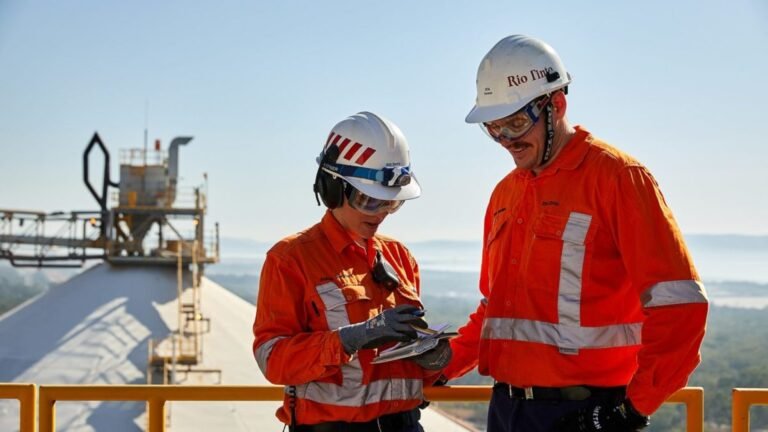
LONDON: Mining giant Rio Tinto has delivered a transformative first-half performance, reporting a 28% increase in underlying EBITDA to $14.8 billion and a 75% jump in free cash flow to $3.8 billion, driven by robust commodity prices and accelerating productivity gains across its global operations.
CEO Simon Trott hailed the results as a “step-change in performance,” with the company’s diversified portfolio proving its resilience. Copper, Aluminium and Lithium together contributed more than 50% of underlying EBITDA, underscoring Rio Tinto’s strategic pivot toward future-facing commodities.
Record Shareholder Returns
The strong cash generation has enabled Rio Tinto to declare an interim ordinary dividend of $3.4 billion – a 43% increase on the previous year – maintaining a 50% payout ratio. Net earnings surged 47% to $6.7 billion, while underlying earnings per share climbed 42% to 421.4 US cents.
“The continued investment in growth drove a 3 per cent increase in copper equivalent production and further strengthened our portfolio diversification,” Trott said, noting that taxes and government royalties contributed $5.6 billion to government coffers.
Productivity Program Gaining Momentum
The company’s multi-year productivity initiative is already delivering tangible results, with $870 million in benefits banked year-to-date. Rio Tinto is on track to achieve an annualised run-rate of $1.8 billion by year-end, supporting a targeted 3% production uplift in copper equivalent volumes and a 4% compound annual reduction in operating unit costs through to 2030.
Operational highlights include Pilbara achieving its highest first-half iron ore production since 2018, while aluminium operations sustained their strong performance. The Oyu Tolgoi copper mine continues its ramp-up, contributing significantly to copper and gold production growth.
Major Projects on Track
The Simandou iron ore project in Guinea reached a major milestone with first high-grade iron ore sales in April. Mine construction and port infrastructure are now more than three-quarters complete, with full rail commissioning achieved in the first quarter.
In lithium, first production at Fénix 1B and Sal de Vida came ahead of plan, while construction of the Rincon full-scale plant is progressing toward approximately 200 kilotonnes per annum of lithium carbonate equivalent capacity by 2028. Three iron ore replacement mines in the Pilbara remain on budget and on track for first ore in 2027.
Financial Strength and Cost Discipline
Operating cash flow increased 32% to $9.2 billion, supporting continued investment in the company’s growth pipeline while maintaining a strong balance sheet. Net debt edged lower to $14.1 billion, with gearing at 16%.
Capital investment of $5 billion in the first half focused on growth, sustaining and replacement projects. The company has maintained its guidance range for full-year capital expenditure at up to $11 billion.
Lower Effective Tax Rate
Rio Tinto’s effective tax rate on underlying earnings fell to 25.2% in the first half, down from 34.5% in the prior corresponding period, reflecting the utilisation of previously unrecognised deferred tax assets and a favourable geographic spread of earnings. Full-year guidance has been revised to approximately 25%, though the rate is expected to return to around 30% from 2027.
Safety Remains Priority
The company reported the tragic loss of two colleagues at Simandou and Kennecott during the first half. “Safety remains our highest priority,” Trott emphasised, noting the launch of the Rio Tinto Management Operating System on 1 July to strengthen safety standards and compliance.
Market Context
The strong financial performance was supported by favourable commodity prices, with copper, gold and aluminium prices up 39%, 53% and 33% respectively year-on-year. Iron ore prices remained resilient with a 2% realised price increase, while lithium carbonate prices more than doubled to $20,714 per tonne.
The company’s diversified portfolio has proven effective in navigating market volatility, with price and exchange rate sensitivities indicating that a 10% movement in key commodities could significantly impact EBITDA – particularly iron ore ($2.3 billion) and copper ($1.1 billion).
Outlook Maintained
Rio Tinto has maintained its 2026 production and sales guidance across all commodities, with copper production expected between 800-870 kt and total iron ore sales projected at 343-366 million tonnes. The company continues to progress its decarbonisation pathway, targeting a 50% reduction in Scope 1 and 2 emissions by 2030 from a 2018 baseline.
With a robust balance sheet, accelerating productivity and a pipeline of growth projects, Rio Tinto appears well-positioned to continue delivering strong shareholder returns while investing in the commodities essential for the global energy transition.