Renewable energy is now growing fast enough to absorb nearly all the new electricity demand being added to the world’s power grids. With solar panel prices at historic lows, batteries rapidly getting cheaper, and a conflict in the Middle East choking oil supplies, the shift away from fossil fuels is happening faster than most experts predicted.
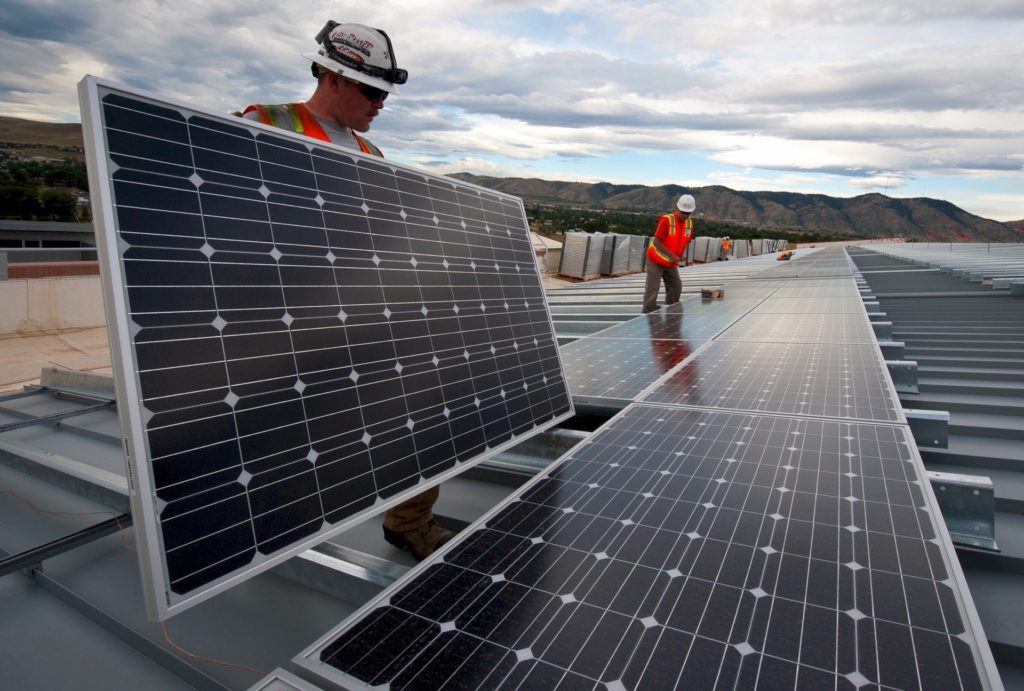
For decades, clean energy was the underdog, expensive, unreliable, and always just a few years away from maturity. That story is over.
The world crossed a quiet but significant threshold: for the first time, solar and wind power are growing fast enough on their own to meet virtually all the new electricity demand being added to the global grid.
And the crisis currently unfolding in the Middle East may push that transition into an even higher gear.
Why solar just keeps getting cheaper
It starts with a number that most people still don’t quite believe. In the mid-1970s, buying one watt’s worth of solar panel capacity cost more than $100. By late 2025, that same watt cost about 10 cents. That’s a 99.6% drop in price over roughly 50 years, and the decline hasn’t stopped.
The pattern is so reliable it has its own name: Swanson’s Law. Every time the total number of solar panels ever built doubles, prices tend to fall by about 20%. This rule has held through trade wars, manufacturing gluts, and global pandemics. No other major energy technology in modern history has matched that pace of cost reduction.

The oldest complaint about solar that it shuts off when the sun goes down is now running out of steam. Battery storage costs fell 20% in 2024, then another 45% in 2025.
Global battery deployment grew 46% last year, reaching 250 gigawatt-hours. Solar plants paired with enough batteries to provide power around the clock are now selling electricity in the United States for around $76 per megawatt-hour. That’s cheaper than building new natural gas capacity from scratch.
China built the cheapest energy technology in history
Much of this price collapse traces back to one country. Chinese factories now produce around 80% of the world’s solar panels, and an even larger portion of the raw materials, polysilicon, wafers, and cells, that go into them.
This dominance was built over two decades through state investment, enormous manufacturing scale, and intense competition that continuously pushed prices down.
That has created political headaches in Washington and Brussels, where governments are debating whether to build rival supply chains and imposing tariffs. But from a purely climate perspective, the math is simple: cheap panels, regardless of where they’re made, cut emissions everywhere.
Key shift in 2025: China’s fossil fuel generation fell 0.9%. Its first decline since 2015, even as total electricity demand in the country rose by 5%. Clean energy capacity grew faster than demand, for the first time. Renewables in China now produce more electricity than all of the country’s homes and service businesses combined.
India followed a similar path. Its fossil fuel generation fell 3.3% while renewable energy production jumped 24% year over year. In both countries, the pattern was the same: new clean power came online faster than electricity demand grew. Clean energy wasn’t just keeping up — it was pulling ahead.
Good progress, but not a victory lap yet
A flat year for coal is not the same as a falling one. Power-sector emissions in 2025 were still near record highs, essentially where they were in 2024 when they set a new peak.
The research firm Ember described the current moment as “the era of clean growth” — a beginning, not a finish line.
Coal’s share of global electricity generation has dropped from 41% in 2013 to 33% today. But the actual coal plants aren’t disappearing. China approved more than 40 gigawatts of new coal capacity in just the first nine months of 2025.
Thanks to the growth of renewables, those plants are increasingly being pushed into backup roles rather than running full-time. But they’re still there. They still burn coal. And they’ll keep doing so for years.
The US is also moving in the wrong direction. The Trump administration’s legislation ended the residential solar tax credit and tightened eligibility for commercial projects.
The Rhodium Group projects this will cut American clean-energy additions through 2035 by more than half — potentially leaving the US seriously behind the rest of the world in a race it helped start.
Even so, policy can slow a market, but it struggles to stop one where the economics have already turned. Global clean energy investment hit a record $2.3 trillion in 2025, up 8% from the year before.
China alone committed around $800 billion to clean energy. India’s spending climbed 15%, reaching about $68 billion. Europe has been accelerating renewables investment since Russia cut off pipeline gas after invading Ukraine. The United States is attempting to swim against a current it no longer controls.
There’s one wildcard that could complicate all of this: artificial intelligence. The IEA estimates global data centre electricity use climbed 17% in 2025, with AI-specific demand growing even faster.
In the US, natural gas is currently the primary new energy source feeding data centres. AI remains the one variable that could outpace clean energy gains in the latter half of this decade.
A war in the Middle East is changing the calculus
History shows that oil shocks can reshape energy systems. After the 1973 OPEC embargo, the United States launched major clean energy programmes — solar research institutes, appliance efficiency standards, and fuel economy rules for cars.
Those investments were partially reversed under Ronald Reagan, but the underlying technologies kept developing quietly for decades. They eventually became today’s commercial solar industry.
This time, the shock is landing differently. The US-Iran conflict has effectively closed the Strait of Hormuz, the narrow waterway through which roughly a quarter of the world’s seaborne oil and a fifth of its liquefied natural gas normally flow. The IEA called it the largest supply disruption in the history of global oil markets.
“As long as we depend on oil and gas, we will continue to pay the price of other people’s wars, which unfortunately will continue and will impoverish us,” said French Prime Minister Sébastien Lecornu.
The difference today is that cheap, scalable alternatives already exist. In March 2026, global solar generation grew 14% year over year, and wind grew 8%. Solar alone saved European energy buyers an estimated $3.5 billion in gas costs in a single month.
Countries that a decade ago might have responded to an oil crisis by drilling harder are now fast-tracking solar farms, offshore wind projects, and grid-scale storage.
How Europe is splitting along energy lines
The crisis is exposing sharp differences between European countries, depending on how much of their electricity comes from renewables. Countries with more clean power are being shielded from the worst price increases. Those still heavily dependent on imported gas are taking harder hits.
Italy, which generates more than 40% of its electricity from gas, saw its benchmark wholesale electricity contract rise over 20% since the conflict began. Germany’s rose over 15%.
France, which gets roughly 70% of its electricity from nuclear power, saw a much smaller increase. Spain, which has pushed renewables to nearly 60% of total generation, actually recorded falling electricity prices.
Albania, where old communist-era hydroelectric dams provide over 90% of the country’s power, largely insulated its consumers from the global price spike.
The impact on ordinary people is real. A baker in central Italy faces rising costs for diesel deliveries, gas-powered ovens, and raw material inputs and has already warned that staffing cuts may be coming if the situation doesn’t improve.
A machine operator in Cyprus, where households pay some of the EU’s highest electricity bills, watched his fuel costs jump 20% and was forced to quit one of his jobs. “I’ve got two jobs and I can barely break even,” he said. “Everything is just going up.”
| Country/Group | Renewables Share | Price Impact Since War | Key Factor |
|---|---|---|---|
| Albania | 90%+ hydro | Lower than last year | Old dams infolink-group |
| Spain | ~60% | Prices fell | Solar/wind surge |
| Italy | <40% gas-heavy | +20% wholesale | Gas reliance |
| Poland | 28% (rising) | Stable, renewables > coal June 2025 | $52B investment euronews |
Governments are responding with clean energy, not more drilling
Some of the most notable responses to the crisis have come from governments leaning further into renewables rather than scrambling for new fossil fuel sources.
Spain, which doubled its solar capacity between 2019 and 2026, issued an emergency decree in March to accelerate electrification, cutting planning red tape, improving grid infrastructure so renewable power isn’t wasted, and making it harder for energy-hungry data centres to operate without clean energy commitments.
France announced €10 billion in state support to help households and businesses switch away from oil and gas. It plans to install an additional one million heat pumps per year and will ban gas boilers in new buildings from 2027.
“Today, 60% of our energy consumption comes from imported fossil fuels, though our domestically produced power is three times cheaper,” the Prime Minister said when announcing the measures.
Portugal has promised a temporary price cap on electricity bills if needed, protecting consumers if retail prices rise more than 70% above the five-year average.
Poland, a country where coal, oil, and gas made up 83% of energy as recently as 2024, announced plans to invest the equivalent of roughly €51.8 billion in renewable energy and storage over the next decade.
The solar industry, meanwhile, pointed out that it has already saved Europe more than €100 million a day since the war began. Without the renewable energy added to European grids over recent years, electricity prices would be significantly higher than they are today.
What comes next is a question of speed
The clean energy transition has always rested on a simple wager: that the technology would keep getting cheaper faster than politics could get in the way. That bet has, so far, paid off.
Solar is now the fastest-growing electricity source in the history of the power industry. Coal appears to be entering its terminal decline. Batteries are beginning to make solar a 24-hour fuel rather than a daylight-only option.
The 1970s oil shock planted seeds that took 40 years to grow into today’s solar industry. The 2026 shock is landing on soil where that crop is already fully grown, already cheap, and already scaling at speed.
The question now isn’t whether the transition will happen — it’s how fast the world chooses to make it go.
Countries with strong renewable foundations are already discovering the answer: when you’re generating your own electricity from the sun and wind, other people’s wars stop being your energy problem.